Global CO₂ Landscape and China’s Climate Vulnerabilities
The global chart helps contextualize which countries drive the largest share of emissions and how their trajectories differ. The China-focused dashboard then zooms in on one of the largest emitters identified in the global view. By layering CO₂ emissions with urban flood exposure across decades, it highlights the intersection of mitigation (reducing emissions) and adaptation (managing climate risks).
Global Context: The Top 20 CO₂ Emitters
This visualization compares per capita and total CO₂ emissions for the world’s 20 largest emitters (2023), covering data from 2004 to 2023.
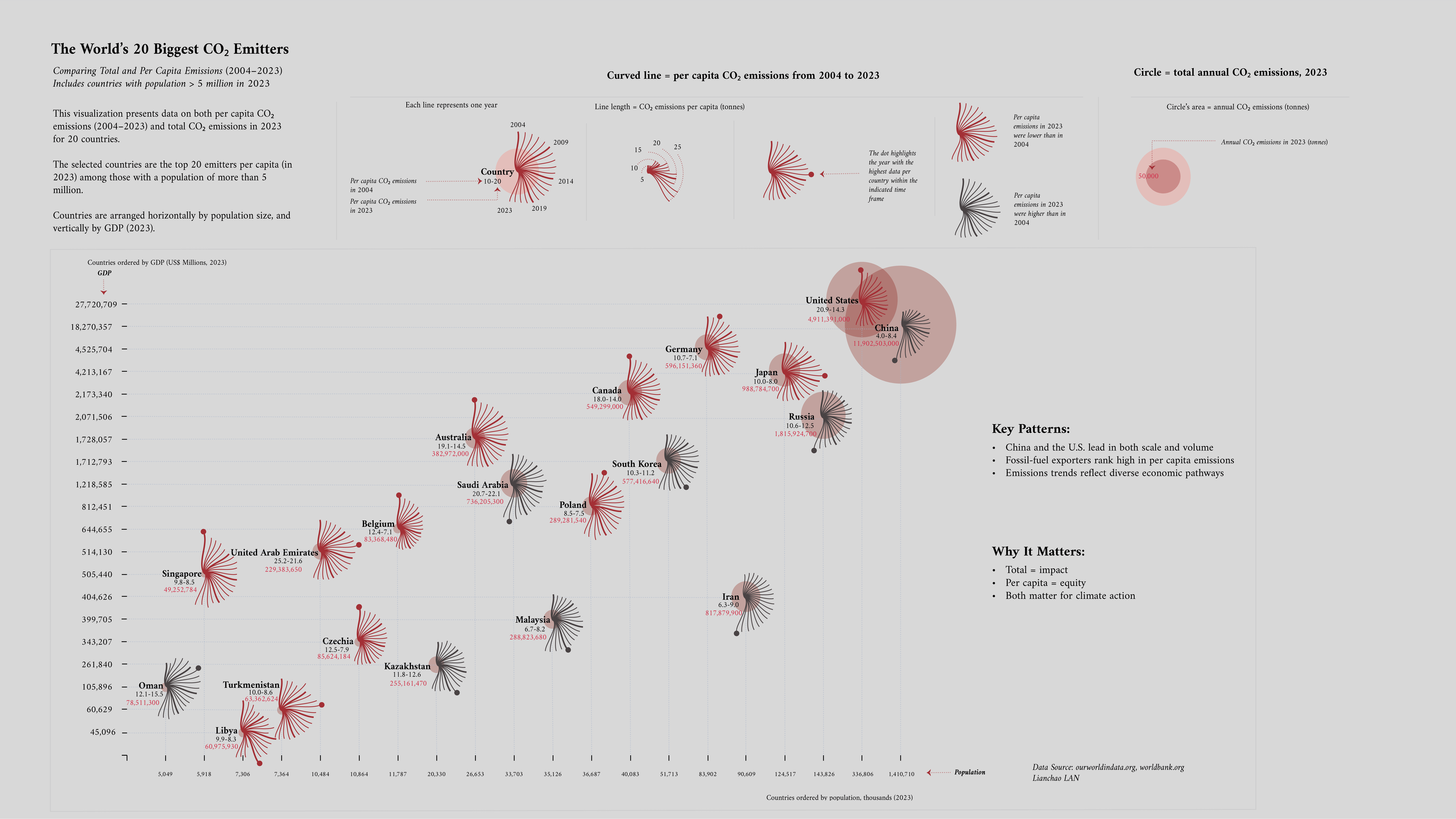
Key findings:
Scale & Equity: The United States and China dominate in total emissions, but their per capita trajectories differ — U.S. per capita emissions remain among the highest, while China’s per capita emissions have risen sharply over the past two decades.
Fossil-Fuel Exporters: Countries such as Saudi Arabia, the UAE and Australia exhibit high per capita emissions despite smaller populations, reflecting carbon-intensive economies.
Diverse Pathways: Some economies (e.g., Germany, Japan) show gradual declines in per capita emissions, while others have plateaued or risen.
China’s Urban Climate Vulnerability
The dashboard maps CO₂ emissions alongside population exposure to flood risk for Chinese urban areas in selected years (1975, 1990, 2005, 2020).
Notable patterns:
Urban Growth & Emissions: Rapid expansion of high-emission cities along the eastern seaboard and major river basins between 1975 and 2020.
Flood Risk Concentration: Many of China’s largest, most emission-intensive cities — including Shanghai, Guangzhou, and Tianjin — are in high flood-exposure zones, heightening climate adaptation challenges.
Population at Risk: Cities with >10 million residents often coincide with high flood-exposure percentiles, suggesting that climate hazards disproportionately affect economic hubs.
Data Sources
Global data: Our World in Data, World Bank (2004–2023)
China urban data: GHS-UCDB R2024A (2025)
The global chart helps contextualize which countries drive the largest share of emissions and how their trajectories differ. The China-focused dashboard then zooms in on one of the largest emitters identified in the global view. By layering CO₂ emissions with urban flood exposure across decades, it highlights the intersection of mitigation (reducing emissions) and adaptation (managing climate risks).
By pairing these perspectives, the project demonstrates how high-level climate metrics connect directly to ground-level resilience challenges.